Kpex Exchange: The Intelligence Flywheel
How a closed-loop data architecture connecting estimators, vendors, and executed project cost data is redefining cost intelligence infrastructure for the global capital project industry.
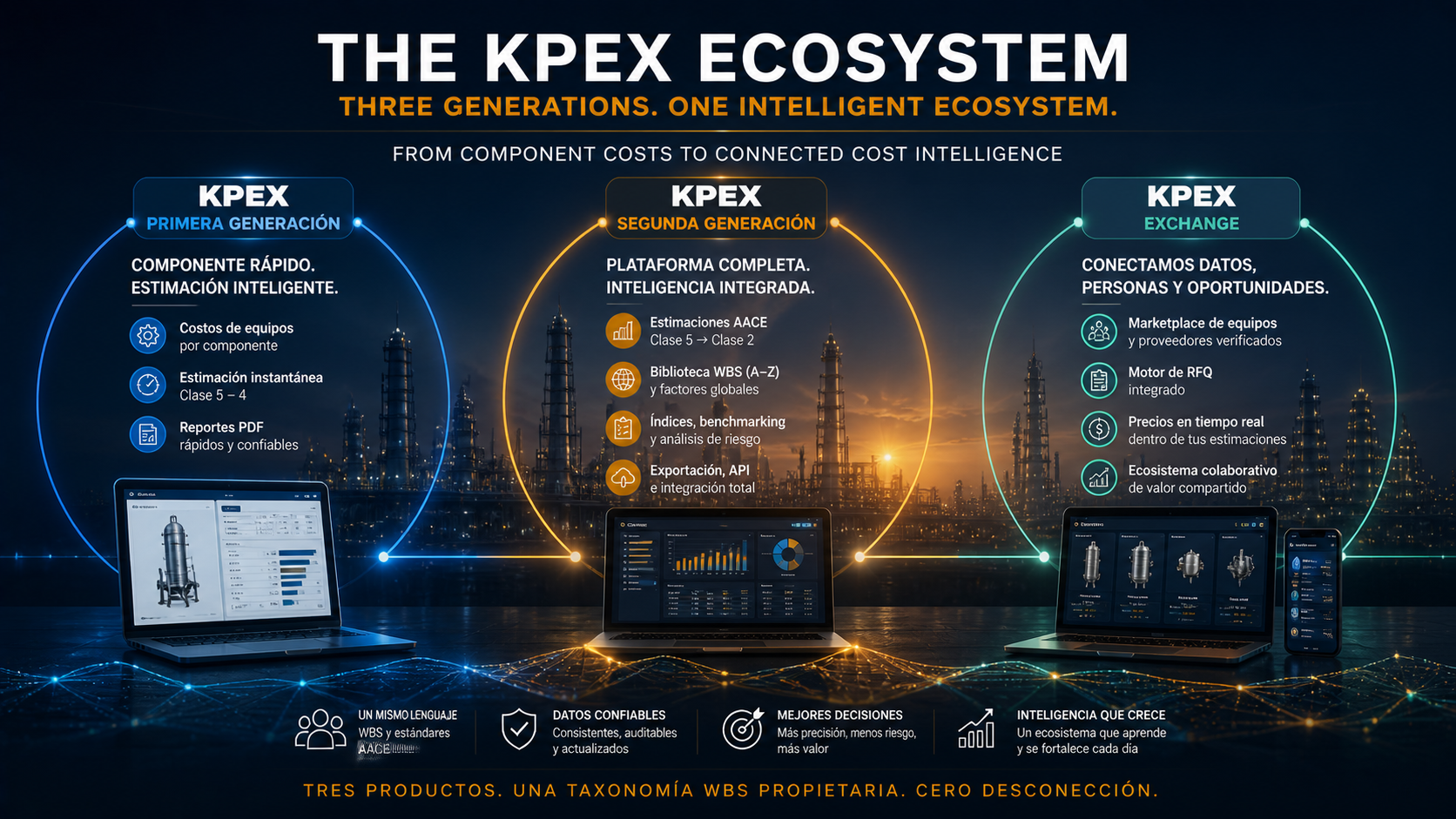
The following analysis is based on a recorded interview with Carlos Fuenmayor, Founder & CEO of CAF Corporation Ingeniería de Costes SL. The interview explores the conceptual architecture, market rationale, and long-term strategic vision behind the Kpex Exchange — the marketplace and intelligence layer integrated within the Kpex CAPEX Cost Intelligence Platform. The content has been structured for academic publication while preserving the full conceptual integrity of the original statement.
Kpex Exchange:
The Intelligence Flywheel — A Conversation with Carlos Fuenmayor, Founder & CEO, CAF Corporation Ingeniería de Costes SL.
1. The Structural Problem: Cost Engineering's Data Gap
Capital cost estimation has been the methodological backbone of project investment decisions for decades. Yet despite its centrality to trillions of dollars in infrastructure and industrial expenditure annually, the underlying data infrastructure that supports it has undergone remarkably little structural evolution. The estimating workflows in use at major EPC firms and owner-operators today differ from those of twenty years ago in interface sophistication — but not in the fundamental architecture of how cost data is sourced, validated, and refreshed.
The problem is systemic and compound. Cost databases — the primary reference tools used by practising estimators to derive parametric cost models for equipment, materials, and labour — are assembled through periodic survey cycles. Data is gathered from contractors, vendors, and operators through structured questionnaires; compiled, normalised, and editorially reviewed; and published as subscription products on an annual or biennial basis. By the time the published data reaches the estimator's desk, it is already historical. The lag between real-world market conditions and published reference data routinely ranges from twelve to twenty-four months. For sectors characterised by high price volatility — renewable energy components, offshore structures, modular LNG, green hydrogen electrolysis systems — this lag is not merely an inconvenience. It is a material source of estimation error.
"If you are an estimator working on a major capital project right now — a refinery, a power plant, a mining processing facility — you are fundamentally doing the same thing estimators were doing twenty years ago. You open a cost database, you look up equipment prices, and those prices were compiled last year. Or the year before. Some of the most widely used reference databases in this industry have data points that are three, four, five years old."
— Carlos Fuenmayor, Founder & CEO, CAF Corporation
The structural asymmetry is particularly acute when one considers the vendor side of the market. Equipment manufacturers and suppliers — the entities that actually produce the assets being priced — possess current, transaction-validated pricing intelligence: live price lists, lead-time curves, regional delivery adjustments, and cost escalation factors derived from real material procurement cycles. This intelligence exists at the granular level required for accurate estimation. It is, however, dispersed across PDF catalogues, email correspondence, and disconnected procurement spreadsheets, with no systematic aggregation mechanism and no formal connection to the estimating workflow.
The consequence is a market-wide information asymmetry that drives conservative contingency loading, creates structural uncertainty in investment decisions, and contributes to the well-documented pattern of cost overruns in major capital projects. According to AACE International, cost overruns in the range of 10–30% relative to authorised budget are routine at Class 3 and above project phases — a pattern that persists in part because the parametric foundations on which early-phase estimates are built do not accurately reflect contemporaneous market conditions.
2. The Genesis of Kpex Exchange
The conceptual architecture of Kpex Exchange did not emerge from a technology-first perspective. It emerged from the accumulated professional experience of practitioners who had spent careers at the intersection of estimation methodology, data quality, and project outcomes — and who had observed, project after project and client after client, the same fundamental bottleneck: not the method, not the software, not the skill of the estimator, but the quality and currency of the underlying cost data.
The central insight that gave rise to the Exchange architecture was structural rather than technical: the solution required an intelligent intermediary capable of sitting between buyers and sellers in the capital project supply chain, extracting a structured signal from every interaction, and converting individual commercial transactions into a continuously improving, continuously validated picture of market-level cost reality.
This framing differs materially from the conventional marketplace model. A marketplace, in its standard form, facilitates transactions between buyers and sellers. The platform derives value from the transaction itself — through commission, listing fees, or subscription revenue — and the data generated by those transactions is a by-product. In the architecture described by Fuenmayor, the causal relationship is inverted: the transactions are the mechanism; the data — and the intelligence derived from it — is the primary product.
"The missing link was, in retrospect, completely obvious once you saw it clearly. You needed an intelligent intermediary — something that could sit between buyers and sellers, extract the signal from every single interaction, and turn those individual transactions into a continuously improving, continuously validated picture of market reality. That is the idea. That is Kpex Exchange."
— Carlos Fuenmayor
3. The Ecosystem Triangle: Architecture of the Exchange
The Kpex Exchange is structured around a three-vertex ecosystem: Buyers, Sellers, and the Exchange itself as an intelligence layer. Understanding this architecture requires treating each vertex not as a generic market participant, but as a node with specific information needs and information contributions.
Vertex 1 — Buyers: Estimators and Project Owners
The buyer population encompasses cost estimators, EPC contractors, owner-operators, feasibility consultants, and project finance teams — any professional entity whose decisions are informed by capital cost data. The fundamental requirement of this group is access to current, accurate, and methodology-aligned equipment pricing, embedded within their estimating workflow with minimal friction. The operative constraint is not the ability to seek pricing — all estimators can and do request vendor quotations — but the time and process overhead associated with obtaining validated pricing at the volume and frequency required for parametric modelling and benchmarking activities.
Vertex 2 — Sellers: Vendors and Equipment Manufacturers
The vendor population comprises manufacturers and distributors of capital equipment across the full range of process plant disciplines: rotating machinery, static vessels, heat transfer equipment, electrical and instrumentation packages, civil and structural components. The key insight regarding vendor participation is that qualified demand — demand arising from an active capital project estimation process — carries a fundamentally different commercial value than generic catalogue enquiries. When an estimator initiates an RFQ within Kpex Exchange, they are not casually browsing; they are actively pricing a project with a real procurement decision in its downstream trajectory. This represents warm, contextualised demand that is demonstrably more valuable to a vendor's commercial development function than cold-channel outreach.
Vertex 3 — The Intelligence Layer: Kpex Exchange
The third vertex — the Exchange itself — is the element that distinguishes this architecture from conventional industrial procurement portals. Kpex Exchange functions as a cost intelligence engine that uses the marketplace as its primary data source. Every interaction that flows through the two-sided market generates a structured input to a machine learning system that continuously refines the parametric cost models underlying the platform's estimation tools.
"Kpex Exchange is a cost intelligence engine that uses a marketplace as its data source. Every single interaction that flows through that triangle — every query, every vendor response, every accepted quote, every project that goes from estimate to execution — becomes a structured input into a machine learning system that continuously recalibrates our understanding of what industrial assets actually cost in the real world."
— Carlos Fuenmayor
The distinction between a marketplace with data capabilities and an intelligence engine that uses a marketplace as its data source is not rhetorical. It determines the fundamental design priority: in a conventional marketplace, data quality is instrumental to improving transaction conversion. In the Kpex architecture, transaction volume is instrumental to improving data quality. The marketplace is structured to generate the richest possible cost intelligence signal; commercial outcomes are a function of that intelligence quality, not its antecedent.
4. The Machine Learning Flywheel: Three Signal Streams
The intelligence layer of Kpex Exchange operates on three distinct, complementary data streams, each contributing a different type of signal to the system's parametric recalibration engine.
Signal Stream 1 — Estimator-Generated Pricing Events
Every time an estimator uses the Kpex platform to price a component within an active project, a structured data record is generated: equipment type, capacity parameter, geographic location, project timestamp, and derived unit cost. This record documents what a trained professional, applying AACE-aligned parametric methodology, assessed a specific asset class to be worth at a specific moment in time. At scale, these records constitute a continuous time-series of professional cost judgement, segmented by asset class, geography, and project phase.
Signal Stream 2 — Vendor-Confirmed Commercial Prices
Vendor responses to RFQs submitted through the Exchange generate a categorically different signal type: not a model-derived estimate, but a vendor-confirmed commercial price for a specific configuration of a specific asset type, at a specific delivery point, at a specific date. These are live market price signals with named sources — structured differently from survey-compiled data in that they are transaction-specific rather than aggregated, and generated continuously rather than periodically.
Signal Stream 3 — Executed Project Cost Data (Ground Truth)
The third signal stream is the most methodologically significant and architecturally novel. Data Partners — EPC firms and owner-operators who have contributed their historical executed project cost data to the Kpex network — provide as-built cost records for completed projects: what the project actually cost, under real field conditions, with real contractor rates, real material prices, and real productivity factors. This constitutes validation data at the ground-truth level. It enables the system to compare its parametric predictions against observed outcomes and to recalibrate its models based on systematic divergences.
| Signal Stream | Data Type | Source | Role in the System |
|---|---|---|---|
| Stream 1 — Estimator pricing events | Parametric model outputs | Estimators using Kpex | Professional cost judgement baseline |
| Stream 2 — Vendor RFQ responses | Transaction-confirmed prices | Equipment manufacturers | Live market price signal |
| Stream 3 — Executed project costs | As-built final accounts | Data Partner EPCs / owners | Ground truth validation |
The recalibration process operates on Module A — the parametric cost database at the core of the Kpex estimation framework. Capacity scaling exponents, equipment installation factors, regional cost indices, and cost escalation curves are continuously adjusted as new data accumulates. In equipment families where market prices exhibit high volatility or rapid structural change — utility-scale battery storage, green hydrogen electrolysis systems, floating offshore structures — the system flags accelerated review conditions and weights incoming signals more heavily in its recalibration algorithm.
The Compounding Flywheel Effect
The strategic significance of this architecture lies not in any individual data stream but in the compounding dynamic generated by their interaction. Better parametric data produces more accurate estimates. More accurate estimates drive higher platform adoption among estimators. Higher adoption generates more RFQ volume through the Exchange. More RFQ volume attracts more vendor participation. More vendor participation produces more market price signals. More market price signals improve parametric calibration. The cycle reinforces itself with each turn, and each new participant in the network increases the value of the network for all existing participants.
"Every user who joins the network makes the data better for every other user on it. That is a network effect with genuine strategic depth — the kind that becomes exponentially harder to replicate the longer you wait."
— Carlos Fuenmayor
This network effect structure carries a specific strategic consequence: the cost of replication increases non-linearly over time. A new entrant attempting to replicate Kpex Exchange after it has achieved meaningful network density would face not just the engineering cost of building the platform, but the prohibitive data acquisition cost of assembling the accumulated signal history that gives the platform its calibration accuracy. The moat deepens with every transaction.
5. The Competitive Landscape: Why Prior Solutions Are Insufficient
Existing cost data products — Richardson Engineering Services, IHS CERA, Aspen ICARUS, Wood Mackenzie cost benchmarks — represent significant bodies of work assembled over decades of editorial effort. Their limitations are not a function of execution quality but of architectural design: they are publishing businesses structured around a periodic survey-and-compile model, not network businesses structured around a continuous transaction-and-recalibrate model.
| Dimension | Traditional Cost Publishers | Kpex Exchange |
|---|---|---|
| Data refresh cycle | Annual / biennial survey cycle | Continuous — every transaction generates a signal |
| Data source | Survey responses (self-reported, voluntary) | Transaction-derived (vendor-confirmed, structured) |
| Validation mechanism | Editorial normalisation | Executed project cost comparison (ground truth) |
| Network effects | None — subscriber count does not improve data quality | Compounding — each new participant improves data for all |
| Value proposition | Compiled historical reference | Live, self-improving intelligence infrastructure |
"The analogy I use is the printed road atlas versus GPS with live traffic. A printed atlas is accurate when it goes to press. But the moment a new road opens, or traffic conditions change, it is wrong — and it will stay wrong until the next edition. GPS with live traffic doesn't just know the road network. It knows which roads are congested right now. And it gets smarter with every car on the network."
— Carlos Fuenmayor
The genuine architectural invention is the closed loop: the integration of the estimating workflow, the vendor price marketplace, and the machine learning optimisation engine into a single system where outputs become inputs. Those three components exist separately across the industry today. What Kpex Exchange does is close that loop — and once it is closed, the compound effect is self-sustaining.
6. Operational Impact: What Changes for Practitioners
The practical implications of a mature Kpex Exchange for the four principal participant categories are substantive and distinct.
For cost estimators and estimation teams: The primary change is the elimination of the currency-of-data problem as a source of systematic estimation error. Parametric models continuously calibrated against live vendor prices and recent executed costs provide a defensible, traceable basis for AACE Class 5 through Class 3 estimates. Contingency loading decisions shift from experience-driven heuristics to data-supported probability assessments grounded in real evidence.
For equipment vendors and manufacturers: The Exchange provides structured access to qualified demand at the pre-commitment phase of the procurement cycle — a commercial exposure channel that does not currently exist in systematic form. The intelligence provided by aggregated estimator query patterns constitutes market intelligence of independent commercial value, independent of individual transaction outcomes.
For Data Partners (EPCs and owner-operators with executed project history): The contribution of anonymised executed cost data to the Kpex network converts historical project data — a sunk cost accumulated in internal databases with no external revenue-generating potential — into a structured asset with a quantifiable market value. The Data Partner model creates a new revenue stream from existing organisational assets and establishes a commercial basis for participation in the intelligence network.
For the capital project industry as a whole: The aggregate impact of a mature Kpex Exchange would be a material improvement in the accuracy and currency of the cost intelligence infrastructure underpinning investment decisions across all capital-intensive sectors. AACE Class 5 estimates — the earliest-phase assessments that drive portfolio screening and preliminary capital allocation — would be grounded in a more current and more validated parametric foundation, with measurable consequences for the incidence and magnitude of cost overruns at project completion.
7. The Long-Term Vision: Cost Intelligence Infrastructure at Market Scale
The strategic ambition articulated for Kpex Exchange is not primarily a marketplace business. It is a benchmark network — an independent, continuously validated, transaction-derived cost intelligence infrastructure serving the global capital project industry at the scale and reliability of financial market data providers.
"The vision is that Kpex Exchange becomes the Reuters of industrial cost data. A trusted, real-time reference that the entire capital project industry — globally, across every sector, every geography, every asset class — relies on the way financial markets rely on Reuters or Bloomberg. Not because we marketed it into that position. Because the data is demonstrably better than any alternative."
— Carlos Fuenmayor
This framing positions the Exchange not as a marketplace with data capabilities, but as a data infrastructure business with marketplace mechanics. The reference to financial market data providers is deliberate and precise: Reuters and Bloomberg are not primarily transaction platforms; they are trusted, independent reference systems whose value derives from the quality, currency, and universality of the data they publish. Their competitive position is sustained not by network effects alone, but by the institutional trust accumulated through decades of consistent accuracy. The analogue in industrial cost engineering is a reference system that is demonstrably more accurate than any alternative, continuously validated against real transactions, and governed as a network asset rather than a proprietary product.
The capital project industry allocates an estimated USD 7–9 trillion annually in infrastructure, energy, and industrial investment globally. The quality of the cost intelligence infrastructure supporting those investment decisions — its accuracy, its currency, and its accessibility — has measurable consequences for how efficiently that capital is deployed. A benchmark network of the scale and architecture described would represent the first genuinely new structural contribution to that infrastructure since the publication of the earliest cost engineering reference manuals in the mid-twentieth century.
"The capital project industry moves trillions of dollars of investment every year. It deserves a cost intelligence infrastructure that matches that scale, that ambition, and that responsibility. That is what we are building."
— Carlos Fuenmayor, Founder & CEO, CAF Corporation Ingeniería de Costes SL
This article is based on the Kpex Exchange Interview Script produced by CAF Corporation Ingeniería de Costes SL as part of the Kpex platform launch communications series. The interview was originally structured for a HeyGen AI video format and has been adapted for academic publication in the Kpex Insights series. All quotations are drawn directly from the original script, authored by Carlos Fuenmayor, Founder & CEO, CAF Corporation. © 2026 CAF Corporation Ingeniería de Costes SL.