Inflation and Escalation in Capital Project Cost Estimation
Escalation is one of the most underestimated risks in capital project budgeting. We examine the methodology for applying escalation factors correctly and the indices that support defensible estimates.

Why Escalation Is Consistently Underestimated
Capital project cost estimates are typically expressed in current dollar terms — the price level at the date the estimate is prepared. But capital projects take years to execute, and the costs incurred during execution are subject to the inflation prevailing at the time of expenditure, not at the time of estimation.
The gap between estimate-date prices and execution-date prices is called escalation. It is one of the most consistently underestimated risks in capital project budgeting and one of the primary drivers of cost overruns on major capital projects.
Inflation vs Escalation
General consumer price inflation and the escalation applicable to capital project costs are not the same thing. Capital projects draw on specific commodity markets — steel, copper, cement, fabricated equipment, specialised construction labour — that move independently of broad price indices. During periods of high capital investment activity, capital cost escalation can significantly outpace general inflation.
Escalation Methodology
A defensible approach requires: a time-phased expenditure forecast (S-curve) broken down by cost component; separate escalation factors for each major cost component; a forward escalation forecast independent of the project team; and documentation of the escalation basis in the estimate basis memorandum.
The CAF Cost Adjustment Index
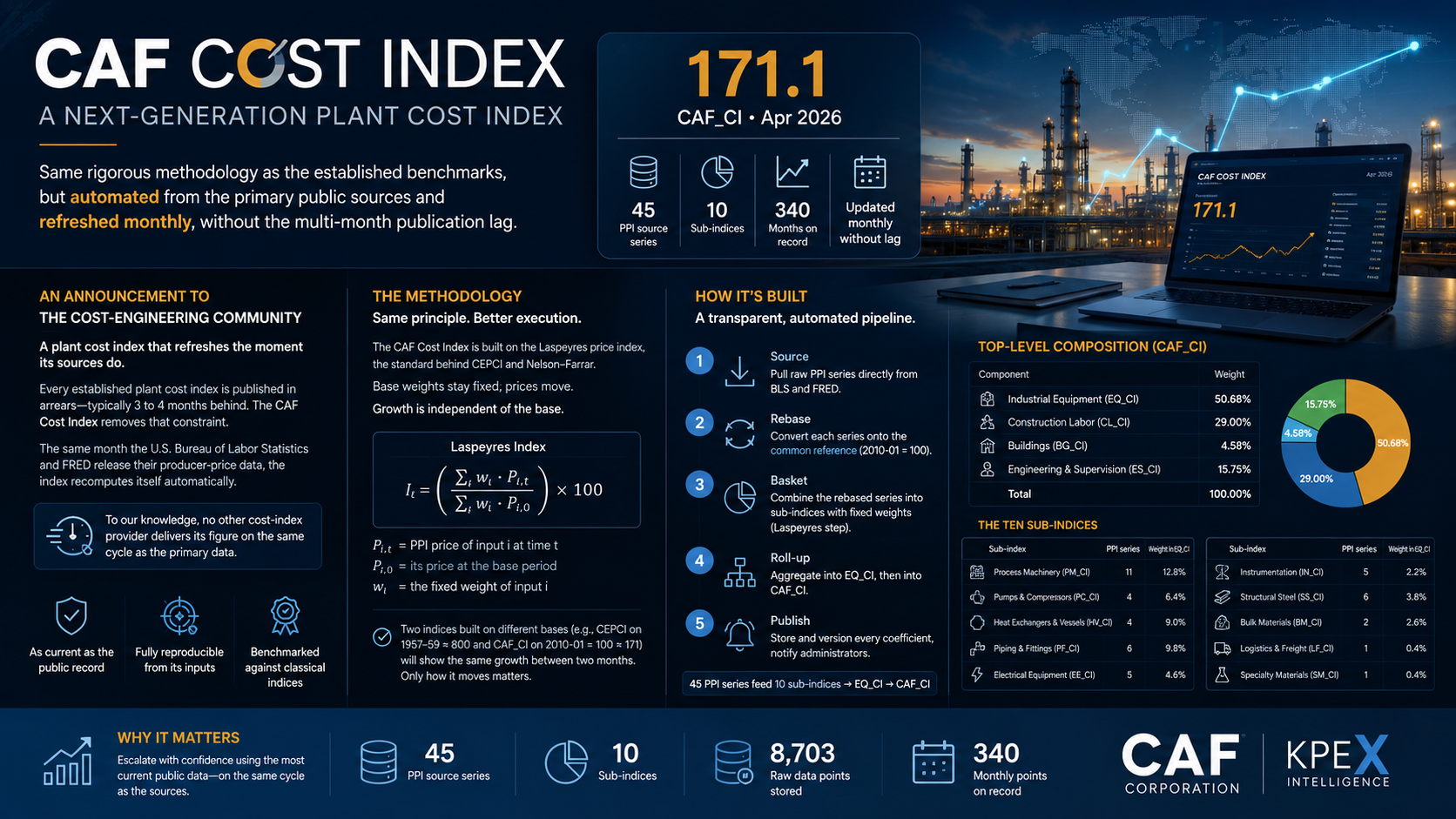
CAF Corporation maintains the CAF Cost Adjustment Index (CAI) — Module Z.5 of the Kpex platform — as a time-series index of capital project cost escalation across regions and commodity categories. The CAI is updated annually and referenced to a base year to allow consistent normalisation of historical project data and forward escalation of current estimates.