Class 1 Cost Estimate: Definitive Estimate for Bid, Tender and Claims
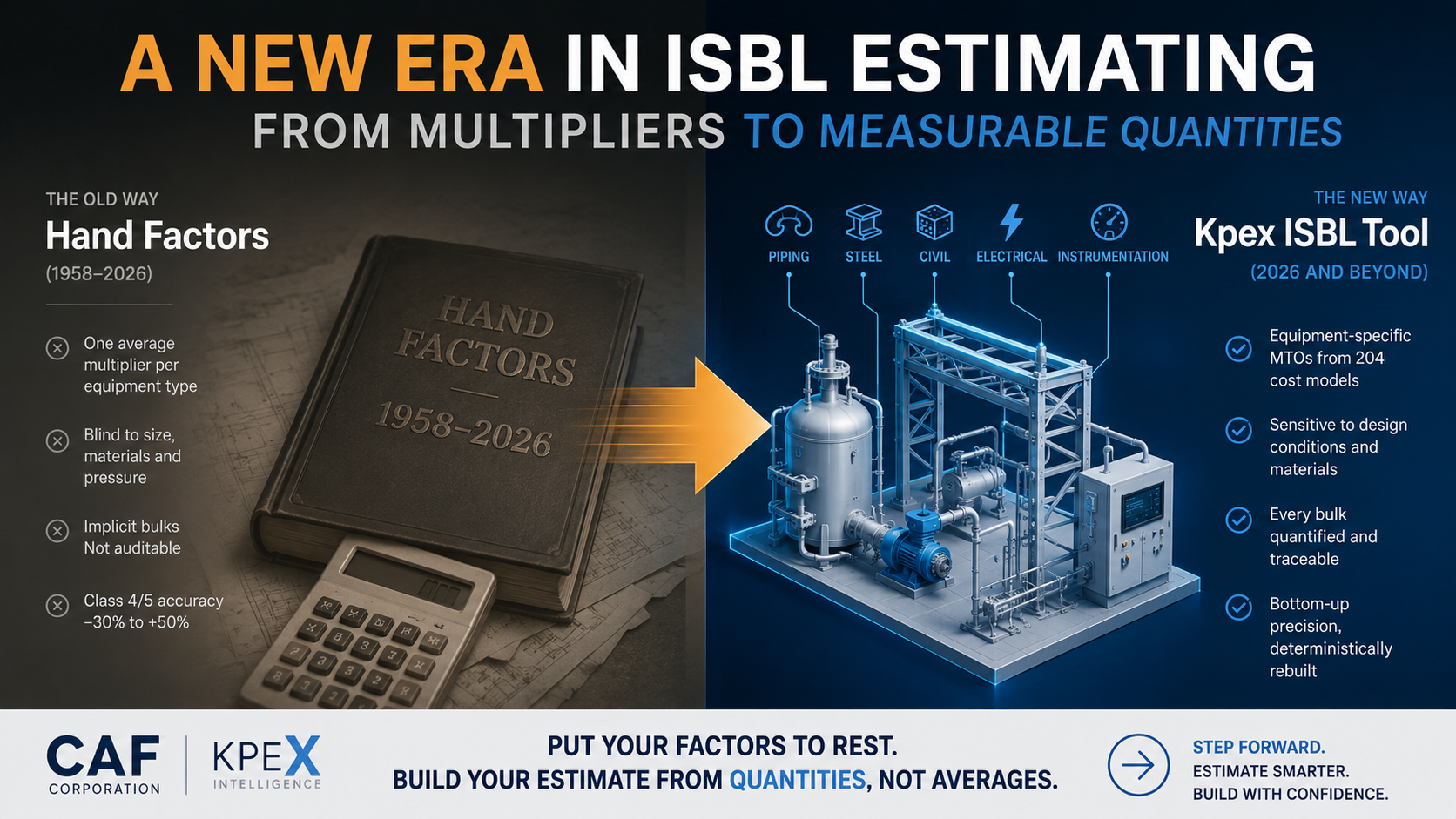
Class 1 is the gold standard of cost estimation — prepared when the project is fully defined, all vendor quotes are received, and every material quantity is confirmed. No shortcuts, no factors.
How Kpex implements Class 1 following AACE 18R-97
Kpex 2G guides the cost engineer through every step of the Class 1 workflow — from scope input to indexed, location-adjusted output — enforcing the AACE recommended methodology at each stage. The platform validates inputs, applies the correct indices automatically, and generates a documented Basis of Estimate aligned with AACE 18R-97.

What Is a Class 1 Cost Estimate?
The Class 1 Definitive (or Check) Estimate represents the highest possible level of cost certainty achievable before physical construction begins. Prepared when engineering is 65–100% complete, it achieves an expected accuracy of −5% to +10% (some references cite ±5–8%).
A Class 1 estimate is used for:
- Lump-sum bid preparation — The number an EPC contractor submits to win a contract
- Tender evaluation — Owner's independent cost estimate against which bids are evaluated
- Claims and disputes — Definitive cost evidence in contractual change order negotiations
- Final investment decision (FID) check — Pre-FID sanity check of the Class 2 control estimate
What Makes Class 1 Different?
At Class 1, there are no factors, no ratios, no analogies. Every cost element is derived from one of three definitive sources:
Firm or budget quotations received for all major and bulk-procured equipment and materials. No estimated pricing.
Every metre of pipe, every tonne of steel, every cable tray run measured from IFC (Issued for Construction) drawings.
Actual bids received from civil, mechanical, piping, and E&I subcontractors for each work package.
Class 1 Workflow — Step by Step
Step 1 — Confirm Complete Engineering Package
Verify that all engineering deliverables required for full takeoff are available and at the correct revision status:
- Piping Isometrics (IFC) — 100%
- Instrument Index and Loop Diagrams
- Electrical Cable Schedules and Single Line Diagrams
- Civil Foundation and Structural Drawings (IFC)
- Equipment Datasheets with confirmed sizing
- Vendor Drawing Approval (VDA) complete for long-lead equipment
Step 2 — Complete Full Material Takeoff (MTO)
Every item in the material control system must be counted and quantified from engineering documents. This is typically performed by a dedicated takeoff team using CAD-integrated MTO software (Smart 3D, PDMS, Tekla, etc.) cross-checked manually for critical lines.
Step 3 — Obtain Firm Vendor Quotations
All purchased equipment, bulk materials (pipe, fittings, cable, structural steel, instrumentation) and package units must have received at minimum two competitive vendor quotations, with the basis of pricing clearly defined (ex-works, delivered to site, duty paid, etc.).
Step 4 — Obtain Sub-contractor Bids
Divide construction scope into sub-contract packages consistent with the planned contracting strategy. Issue enquiries, receive bids, and level bids for scope and commercial terms. Use the lowest technically compliant bid for the estimate.
Step 5 — Price Direct Construction Labour
For self-performed work (if any), apply definitive all-in crew rates from the signed or anticipated labour agreements. All productivity adjustments (shift schedule, weather, site conditions, labour availability) must be formally documented and justified.
Step 6 — Price Indirects from Staffing Plan
The indirect cost estimate at Class 1 is derived from a detailed staffing plan — named or functional positions, for defined durations, at confirmed salary/rate levels. No indirect cost percentage factors are acceptable.
Step 7 — Escalation and Currency
Apply escalation from the quotation validity date to the expected purchase order date and, for labour, to the mid-point of that work's execution window. Use project-specific escalation forecasts where possible; fallback to published indices (CEPCI, ENR CCI) for materials.
Step 8 — Risk and Contingency
At Class 1, contingency is narrow — typically 3–8% of TIC — and is supported by a formal Quantitative Risk Analysis (QRA). Remaining risks are specific, identified, and quantified. Management Reserve is minimal.
Class 1 vs. Class 2 — Key Differences
| Dimension | Class 2 | Class 1 |
|---|---|---|
| Engineering | 30–70% | 65–100% |
| Material pricing | Market rates / budget quotes | Firm vendor quotations |
| Labour pricing | DB crew rates × productivity | Signed labour agreement or sub-bid |
| Indirects | Detailed line-by-line or % | Full staffing plan, named positions |
| Accuracy | −10% / +20% | −5% / +10% |
| Contingency | 5–15% | 3–8% |
| Time to prepare | 4–10 weeks | 6–16 weeks |
Class 1 in Practice — Common Uses
EPC Lump-Sum Bid
When an EPC contractor bids on a lump-sum contract, they commit to a fixed price. Their internal Class 1 estimate is the basis for that commitment. The contractor carries all cost risk beyond the stated contract allowances. Any gap between the Class 1 estimate and the submitted bid price represents the contractor's intended margin.
Owner's Independent Cost Estimate (ICE)
Before evaluating bids, sophisticated owners prepare an Independent Cost Estimate at Class 1 level. Bids that deviate more than ±10–15% from the ICE trigger detailed scope alignment reviews. This is standard practice in regulated industries (nuclear, government infrastructure) and large-scale O&G projects.
Contract Claims
When a scope change is disputed, a Class 1 estimate prepared by a qualified cost engineer — with full documentation, MTO, and pricing evidence — constitutes defensible evidence in arbitration or litigation. AACE Recommended Practice 29R-03 addresses claims methodology directly.
The Role of Kpex at Class 1
While Class 1 estimates are built on project-specific data (vendor quotes, sub-bids, IFC drawings) rather than database lookups, Kpex supports the process through:
- Inherited WBS from Class 2 — The estimate hierarchy carries forward; quantities and rates are updated in place
- Z.2 / Z.3 cross-check — Sub-contractor bids can be benchmarked against the Kpex labor and equipment rate database to identify outliers
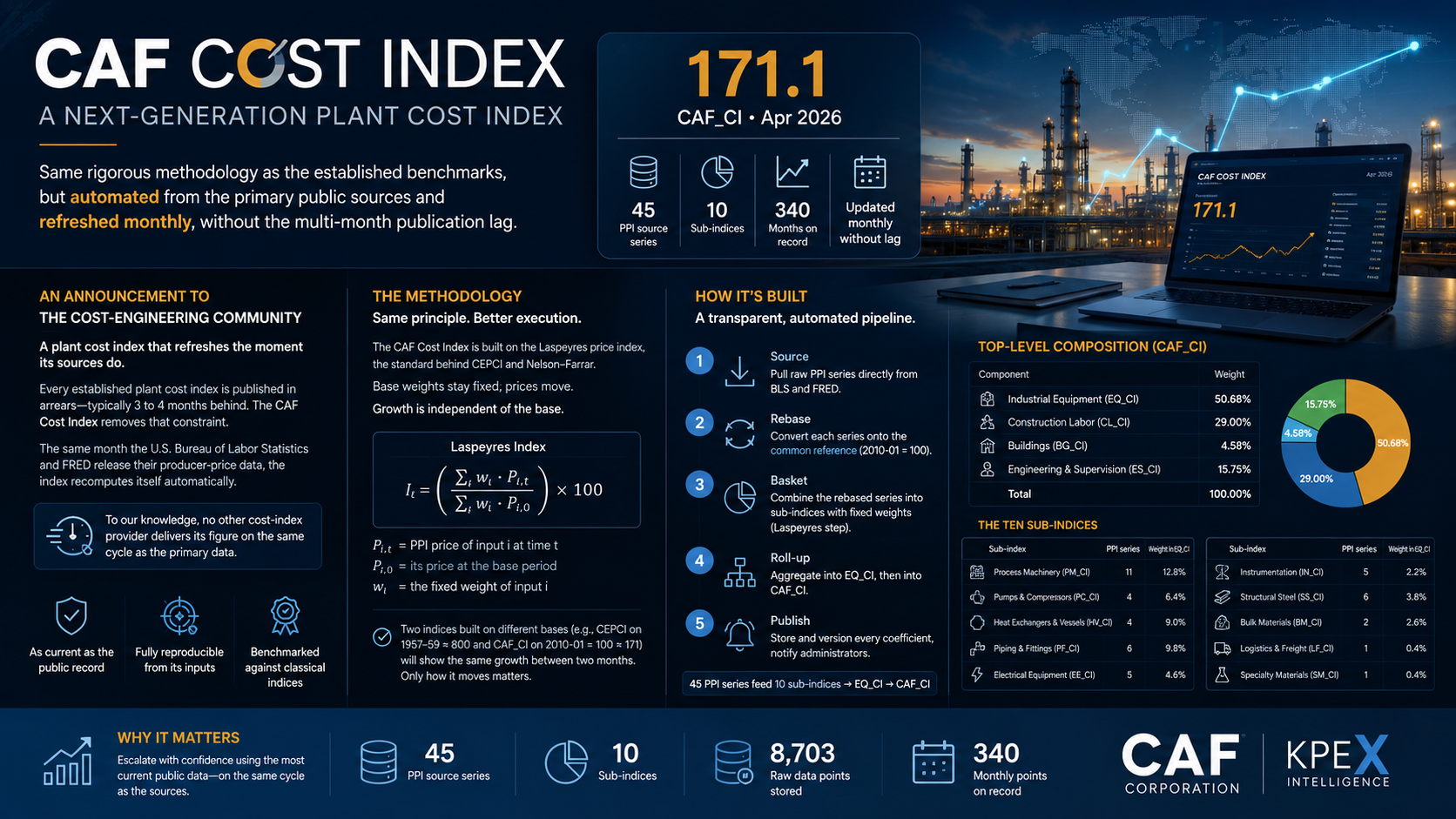
- Z.5 CAI escalation — Applied to quotations received at different dates to bring all pricing to a common basis date
- Basis of Estimate template — Kpex generates the BoE document with all estimate metadata, assumption logs, and index references
- Benchmark validation (Module B) — The Class 1 TIC per unit of capacity is validated against historical project benchmarks for anomaly detection
Class 1 in Kpex — Step by Step in the Platform
- Inherit the Class 2 WBS. Kpex promotes the Class 2 control estimate to Class 1 — structure, quantities, and crew assignments are carried forward as the starting point.
- Replace all estimated pricing with confirmed data: enter firm vendor quotation values at each L4 equipment node; replace crew rate estimates with signed-agreement rates where available.
- Reconcile quantities against IFC MTO. Kpex flags any L4 nodes where the quantity deviates >5% from the Class 2 value, prompting the estimator to confirm or update.
- Apply Z.5 CAI for quote date normalisation. Vendor quotes received on different dates are escalated/de-escalated to a common basis date automatically using the CEPCI or ENR index stored in Module Z.5.
- Benchmark TIC against Module B (Historical Project Benchmarks). Kpex plots the Class 1 TIC/unit-of-capacity against historical projects of the same type — outliers are flagged for estimator review before finalisation.
- Validate indirects against staffing plan. Enter the full project staffing schedule; Kpex calculates indirect cost from position × duration × rate, replacing any percentage-based factors still carried from Class 2.
- Formal QRA for contingency. The Z.6 CRI assessment and the project risk register feed a Monte Carlo simulation; Kpex outputs P50 and P80 cost estimates with contingency defined as P80 minus deterministic base.
- Generate the Definitive Estimate report: full WBS cost tree, vendor quote register, MTO reconciliation summary, CRI/PDRI scores, QRA output, and AACE Class 1 certification block — ready for bid submission, FID package, or claims file.
AACE References
- AACE 18R-97 — Cost Estimate Classification System
- AACE 29R-03 — Forensic Schedule Analysis
- AACE 96R-16 — Basis of Estimate
- AACE 58R-10 — Escalation of Lump-Sum EPC Contracts
- AACE 73R-15 — Contingency and Management Reserve